Most free dental marketing reports produce a score. Very few explain whether the problem is visibility, trust, website friction, weak follow-up or poor measurement. That distinction matters because a faster website will not fix unanswered enquiries, and more Instagram reach will not fix an invisible Google Business Profile.
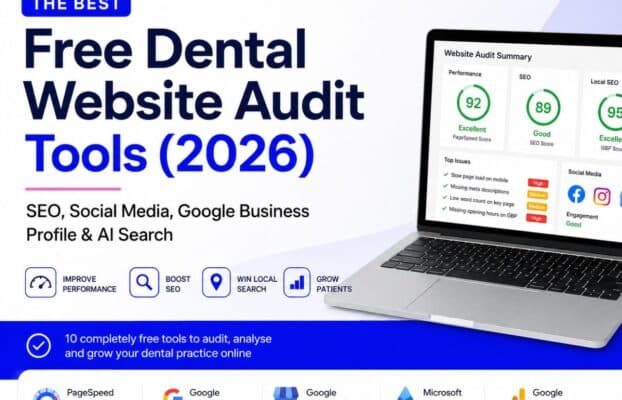
This guide is deliberately different from a generic “best tools” list. It gives every tool a job, a dental-specific question and an action threshold, so your team can finish with decisions rather than screenshots.
01.What a dental marketing audit should actually measure
A useful audit follows the patient journey. It does not begin and end with traffic.
- Discoverability: Can nearby patients find the practice for relevant treatment and emergency searches?
- Technical experience: Does the site load quickly and work properly on the devices patients use?
- Trust: Do reviews, clinician information, photography, treatment detail and compliance signals reduce uncertainty?
- Conversion: Can a patient call, enquire or book without confusion or unnecessary steps?
- Content performance: Are social posts creating useful actions, not only reach and likes?
- Measurement: Can you connect a source to an enquiry, consultation, attendance and treatment?
- AI visibility: Does the practice appear when patients ask conversational search tools for local recommendations?
The order matters. Fix tracking before celebrating a lower cost per lead. Fix a broken booking form before publishing more content. Fix inaccurate opening hours before trying to improve local rankings.
02.The 9 best free dental website and social audit tools
Use it to answer: Is a slow mobile experience making patients abandon treatment pages before they contact the practice?
Test the homepage, contact page and your three highest-value treatment pages separately. Do not rely on one site-wide score. Pay particular attention to Core Web Vitals, oversized images, layout shifts and scripts that delay interaction.
Use it to answer: Which treatments and locations already generate impressions, and where is the practice being seen but not chosen?
Compare queries by page, device and location. Look for high-impression searches with weak click-through rates, treatment pages losing clicks and pages excluded from indexing. Search Console is also the quickest way to spot whether Google can properly discover your important pages.
Use it to answer: Are nearby patients finding and acting on the practice in Google Search and Maps?
Review search terms, calls, website clicks, direction requests and booking actions. Then check the profile manually for inconsistent categories, services, hours, photos and unanswered reviews. For a dental practice, local visibility and profile trust often influence the decision before a patient reaches the website.
Use it to answer: Where do real visitors hesitate, repeatedly click or abandon the page?
Heatmaps and session recordings reveal problems that a traffic report cannot: mobile menus that hide the booking route, forms that feel too long, price sections nobody reaches, and calls to action that look clickable but are not. Review recordings by landing page and device rather than watching random sessions.
Use it to answer: Which channels and landing pages create meaningful actions?
Configure events for calls, forms, booking clicks, WhatsApp clicks and downloadable treatment guides. Segment by channel and landing page. A page with modest traffic but a strong enquiry rate can be more valuable than a high-traffic article with no next step.
Use it to answer: Which content earns attention from potential patients and which content creates action?
Compare reach, watch time, saves, profile visits, messages and link clicks. For treatment education, saves and meaningful watch time often reveal more than likes. Separate practice-culture content from treatment-demand content so each is judged by the right outcome.
Use it to answer: Which websites link to your dental practice, and are competitors earning stronger local or industry references?
Enter your domain and review the backlinks and referring domains shown by the free checker. Look for links from local organisations, dental publications, suppliers, professional bodies and reputable directories. Compare the quality and relevance of links rather than chasing a large raw number.
Use it to answer: Which keywords, content gaps and technical opportunities deserve further investigation?
Use the collection of free Ahrefs tools to explore keyword ideas, inspect search results and carry out quick SEO checks. For a dental practice, begin with commercially relevant treatments and local searches, then identify questions patients ask before booking.
Use it to answer: How does your website's relative authority compare with nearby dental competitors?
Check your domain and a small set of genuine local competitors. Authority is not a Google ranking score, but it can help reveal whether competitors have built a stronger backlink profile and wider online presence. Use it as a comparison signal, not a standalone target.
Manual AI visibility check
AI searchUse it to answer: When a patient asks an AI tool for a local dentist or treatment provider, is your practice present, accurately described and supported by credible sources?
Create a fixed prompt set using realistic questions such as “Who offers dental implants near [town]?” and “Which local dentist has strong options for nervous patients?” Test the same prompts across leading answer engines, record mentions and citations, and repeat monthly. Treat this as directional research, not a guaranteed ranking report.
03.A 60-minute dental marketing audit workflow
You do not need to inspect every metric. Use this sequence to find the biggest commercial problem quickly.
- Minutes 0-10: Test the patient journey. Open the site on mobile. Try to find a treatment, trust the clinician, understand the next step and make an enquiry.
- Minutes 10-20: Check speed and technical health. Run PageSpeed Insights on the homepage, contact page and one priority treatment page. Check indexing and structured data.
- Minutes 20-30: Review local discovery. Inspect Google Business Profile searches and actions, then compare the visible profile with three nearby competitors.
- Minutes 30-40: Watch behaviour. Review Clarity recordings for the priority landing page and identify repeated friction.
- Minutes 40-50: Review social content. Compare the last 90 days by format, topic, watch time, saves, messages and clicks.
- Minutes 50-60: Check measurement and AI visibility. Confirm key events are tracked, then run the fixed AI prompt set and record the baseline.
Do not leave your audit as a document.
Wise Agency can carry out the audit for you, explain what the data means and turn every finding into a prioritised action plan. Our reporting covers visibility, website performance, conversion journeys, local search, social media, tracking and AI search. You receive clear recommendations, practical solutions, named priorities and ongoing reporting so the work leads to measurable improvements rather than another PDF that is never implemented.
Ask Wise Agency to audit your practice04.How to prioritise the findings
Score each issue by impact, confidence and effort. This stops easy cosmetic changes pushing urgent revenue leaks down the list.
Wise priority score
Priority = (patient impact × evidence confidence) ÷ effort
Start with issues that block or mismeasure demand. A visual refresh can wait. Lost calls, failed forms, untracked enquiries and inaccurate local information cannot.
05.How to make the audit useful for AI search
AI visibility is not created by adding “AI SEO” phrases to every paragraph. Answer engines need clear, consistent and corroborated information.
- Define the entity: Keep the practice name, address, clinicians, services and locations consistent across the website and trusted profiles.
- Answer specific patient questions: Build treatment content around suitability, process, costs, recovery, risks and alternatives.
- Show evidence: Use clinician credentials, original case explanations, transparent policies and verifiable practice information.
- Improve crawlability: Use clear internal links, descriptive headings, structured data and indexable pages.
- Earn external confirmation: Strengthen reputable local and industry references rather than relying only on self-published claims.
- Maintain freshness: Review prices, team details, technology, opening hours and service availability regularly.
The goal is not merely to be mentioned. It is to be described accurately, for the right treatment and location, with sources a patient can trust.
06.Where free audit tools stop being enough
Free tools are excellent for finding symptoms. They do not automatically diagnose the commercial cause.
| Free tools can show | They usually cannot prove alone |
|---|---|
| A form submission or phone click | Whether the enquiry booked, attended or accepted treatment |
| A ranking or impression change | Whether the traffic is commercially valuable |
| A video with strong reach | Whether it influenced patient choice |
| A page with high exits | Whether the issue is offer, trust, usability or follow-up |
| An AI mention | How stable or influential that mention is across patients and prompts |
Once a practice is investing consistently in SEO, paid media, content or a new website, the reporting should connect marketing source to booked and attended patients. That normally requires disciplined call tracking, CRM stages and cooperation from the front-of-house team.
Visibility is only stage one.
Wise connects dental SEO, Google Ads, websites, content and tracking so the practice can see what creates enquiries and what becomes a patient.
Explore Wise Agency →07.Final checklist: what to fix first
- Tracking that is missing, duplicated or unreliable.
- Forms, calls or booking routes that fail on mobile.
- Inaccurate Google Business Profile information.
- Slow high-value treatment landing pages.
- Treatment content that does not answer patient concerns.
- Weak proof, clinician visibility or review signals.
- Social content measured only by likes or followers.
- AI answers that omit or inaccurately describe the practice.
A strong audit should make the next decision easier. If the output is a 40-page PDF with no order, owner or deadline, it is reporting theatre. Keep the evidence. Remove the noise. Fix the highest-impact patient leak first.