At Wise Agency, we work with dental practices every day across websites, SEO, Google Ads, Meta Ads, social media and treatment content. One thing we always come back to is this: dental marketing is not the same as ordinary consumer marketing.
A dental practice is not selling a simple product. Patients may be nervous, unsure about their options, comparing costs, looking for reassurance or trying to understand whether a treatment is right for them. That means every advert, landing page, caption, leaflet and website section needs to be written with care.
The aim is not to make dental marketing boring. The aim is to make it clear, honest and useful while still helping the practice stand out. Strong marketing can be persuasive without being misleading, confident without overpromising and patient-focused without losing commercial purpose.
01.The core principle: accurate, honest and not misleading
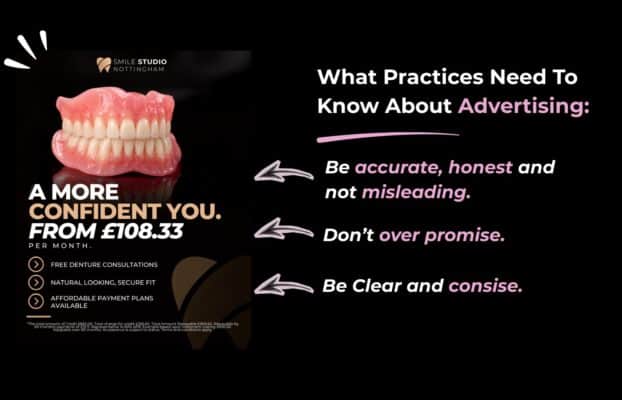
The central message of dental advertising guidance is simple: information given to patients should be accurate, clear and not likely to mislead. That applies whether the content is a printed leaflet, a Google ad, a website treatment page, an Instagram Reel, a TikTok caption or a before-and-after post.
For practices, this means avoiding claims that sound impressive but cannot be properly supported. Wording like “guaranteed results”, “the best dentist”, “pain-free treatment” or “perfect smile every time” can create expectations that may not be realistic for every patient.
What this means for everyday practice marketing
- Make treatment information easy for patients to understand.
- Explain that suitability depends on consultation, assessment and medical history.
- Use factual claims that can be backed up if questioned.
- Avoid vague phrases that could be interpreted in more than one way.
- Do not imply a result is certain when outcomes can vary from patient to patient.
- Keep team, treatment, qualification and pricing information up to date.
02.Social media, paid ads and treatment promotions
Social media is now a major part of how dental practices build trust. Patients often see the team, the practice environment, treatment transformations and patient education long before they enquire.
That is why captions, ads and creative should be written carefully. If a practice advertises Invisalign, implants, composite bonding, whitening, facial aesthetics or another treatment, the content should not imply that every patient will be suitable or that the same outcome is guaranteed.
A safer and clearer approach is to include wording that makes the assessment stage obvious. For example, phrases such as “subject to consultation”, “following a clinical assessment” or “suitability will be discussed at your appointment” help keep the message balanced.
Examples of stronger wording
“Get the perfect smile with implants.”
“Dental implants may be an option for replacing missing teeth, following a consultation and assessment.”
“Pain-free treatment guaranteed.”
“We focus on making your visit as comfortable and supportive as possible.”
Product mentions and endorsements
If a practice recommends a product, system or brand, the wording should stay factual. It should not suggest that the whole dental profession agrees with that view, and it should not exaggerate the benefits. The safest content explains why that product may be suitable in a specific context and avoids making broad, unsupported claims.
03.What dental practice websites need to make clear
A dental practice website is often the first place patients go to check whether the practice feels trustworthy. It should be more than a digital brochure; it should give patients the practical information they need to make an informed next step.
For dental professionals named on the site, practices should make sure professional details are shown clearly, including qualifications, country of qualification where relevant and GDC registration numbers. For the practice itself, the website should clearly display the practice name, location, contact information and important patient information.
- The name and geographic address of the dental service.
- Telephone number and email address.
- Whether the practice is NHS, mixed or private.
- Relevant GDC information or a link to the GDC website.
- Complaints procedure and where patients can go if they are not satisfied with the response.
- The date the website was last updated.
- Accurate team pages that reflect who currently works at the practice.
04.Specialist titles, qualifications and how to word experience
Specialist wording needs particular care. If a dentist is on a relevant GDC specialist list, they can use specialist titles in line with that registration. If they are not on a specialist list, wording should not imply specialist status.
For many practices, the issue is not intentional misrepresentation; it is wording that sounds harmless but could be misunderstood by patients. Phrases such as “implant specialist”, “smile specialist” or “orthodontist” should be checked carefully before being used.
Where accurate, practices may be able to use wording such as “special interest in”, “experienced in” or “practice limited to”. The key is that the wording should match the clinician’s training, competence and professional status.
Letters after names and memberships
Patients may not understand the difference between a qualification, membership, fellowship or honorary title. For that reason, abbreviated letters after a clinician’s name should be used with care and only where they are appropriate, clear and not likely to mislead.
05.How Wise approaches dental advertising for practices
At Wise, our job is to help dental practices grow while keeping the message clear and patient-focused. We are not a regulator and this is not legal advice, but we do build dental websites, campaigns and content with awareness of the standards practices are expected to work within.
Our approach is to write marketing that feels confident without relying on exaggerated claims. We focus on the patient journey, treatment education, trust signals, team visibility, website structure, search intent and clear calls to action.
- For websites: we structure treatment pages around patient questions, suitability, benefits, process, FAQs and clear enquiry routes.
- For ads: we avoid overpromising and make the consultation stage clear where needed.
- For social media: we keep captions simple, human and balanced, especially around transformations and high-value treatment.
- For SEO: we write useful content that answers real patient searches without making unsupported clinical claims.
- For practice teams: we flag wording that may need checking internally before it is published.
Need help making your website clearer?
Wise builds dental websites that combine patient trust, SEO, treatment-page content and clear conversion journeys.
Explore Dental Website Design →06.Quick dental advertising checklist for practices
Before publishing a dental advert, website page, leaflet or social media post, it is worth checking the content against a simple internal checklist.
- Is the claim accurate and easy for a patient to understand?
- Could the wording create an unrealistic expectation?
- Have we made treatment suitability and assessment clear where needed?
- Are GDC numbers and professional details correct where clinicians are named?
- Is the practice status clear: NHS, mixed or private?
- Are prices, offers and finance details current and explained clearly?
- Are before-and-after examples genuine and presented responsibly?
- Have we avoided specialist titles unless the clinician is on the relevant specialist list?
- Is the complaints information easy for patients to find?
- Has someone at the practice checked the final wording before publication?
07.Final thoughts
Good dental marketing should never rely on pressure, confusion or exaggerated promises. The strongest practices are usually the ones that communicate clearly, answer patient questions properly and make it easy for people to take the next step with confidence.
For Wise and the dental practices we work with, the goal is simple: create marketing that attracts the right patients while protecting trust. When a website, advert or social post is clear and honest, it does more than meet expectations. It helps patients feel safer, better informed and more ready to enquire.