01.If Your Google Ads Aren't Delivering, There's Usually a Reason
Google’s latest direction is one of the biggest announcements dental advertisers have had to deal with. Search campaigns are moving further away from manual keyword control and further towards AI-led matching, bidding and optimisation. That means the structure behind your account now matters more than ever.
The breakthrough discovery is this: most struggling dental campaigns are not failing because the practice is unattractive, the website is poor, or the ads are badly written. They are failing because Google’s system now needs far more data, cleaner conversion signals and more concentrated budgets than most dental accounts are giving it.
This guide breaks down what changed, why the announcement matters, what Google’s AI needs to perform properly and how dental practices should structure campaigns before the platform makes those decisions for them.
How Smart Bidding learns and why it's not a monthly reset, how many conversions Google actually needs, why lead quality beats lead volume, how budget affects performance, why budget concentration matters and a practical action plan for getting your account right.
02.Google Ads Doesn't Reset Every Month, And That Changes Everything
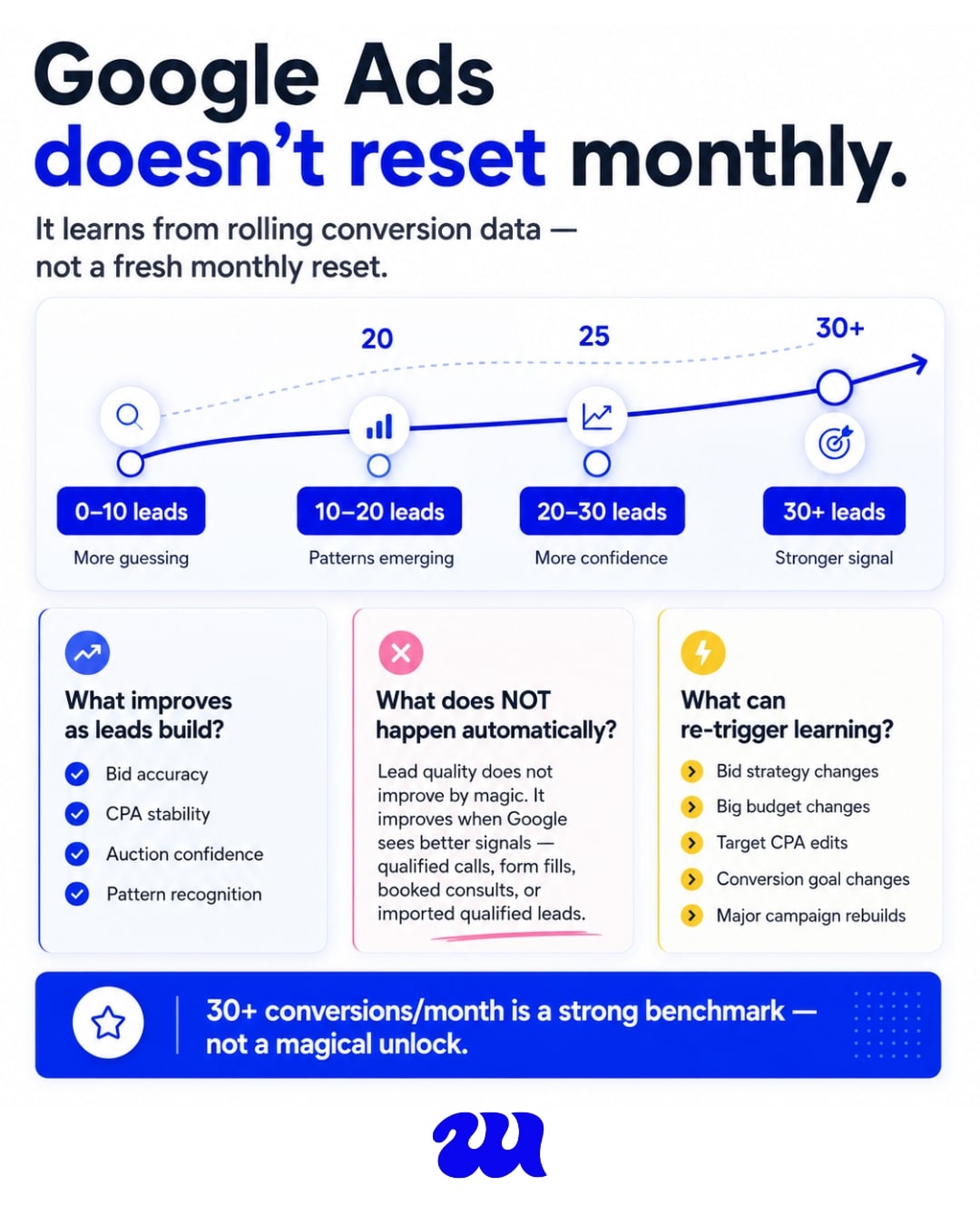
One of the most common misunderstandings we encounter with dental practice owners is the belief that Google Ads "starts fresh" at the beginning of each month. It doesn't. Smart Bidding, the system Google uses to decide when to show your ad, how much to bid and who to target, learns from a continuous, rolling window of data.
That means the decisions Google makes in June are informed by what happened in April and May. Not just the last 30 days. The algorithm is constantly building a picture of what a valuable visitor looks like for your practice and the more signal it has, the better its predictions become.
This has a few practical implications that most practices aren't accounting for:
- If you pause a campaign for a month to "save budget," you're not just pausing spend, you're interrupting Google's learning, which takes time to rebuild once you resume.
- If you make a major change (like switching bid strategy, significantly increasing budget, or changing your conversion goals), Google re-enters a learning phase. Your results will likely dip before they improve.
- Campaigns that have been running for 3–6+ months with consistent data will almost always outperform newer campaigns at the same spend level, because the algorithm has more to work with.
- Month-on-month performance comparisons can be misleading, seasonal patterns, learning phases and rolling signal accumulation all affect results in ways that don't show up neatly in a monthly report.
"Recent data matters most, but historical conversion data still informs every auction Google enters on your behalf."
The takeaway: treat your Google Ads campaign like a long-term investment, not a monthly expense. The goal isn't just to spend this month's budget efficiently, it's to accumulate enough quality signal that Google keeps getting smarter about which patients to bring to your door.
03.The Learning Phase: Why Your First 60–90 Days Look Different
When you launch a new Google Ads campaign, or make a significant change to an existing one, the algorithm enters what's called a learning phase. During this period, Google is actively testing different auctions, assessing which signals correlate with conversions and calibrating its bidding model.
Performance during this period is often inconsistent. You might see your cost per lead swing significantly week to week. Some days will look great. Others will look like you've wasted your spend. This is normal and the worst thing you can do during a learning phase is make reactive changes, every significant change resets the clock.
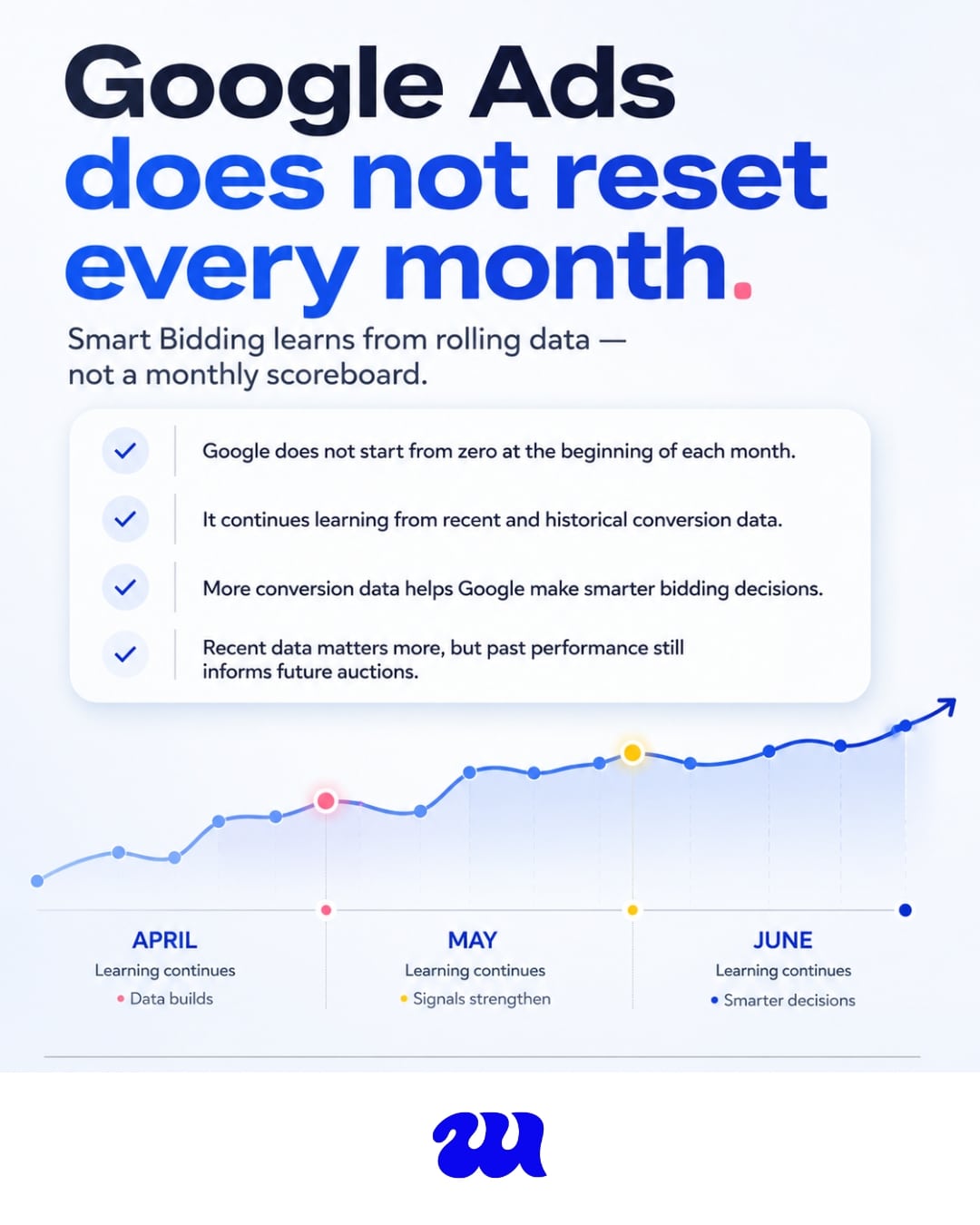
Here's what the learning curve actually looks like across different conversion volumes:
It's also important to understand what doesn't improve automatically as lead volume grows. Lead quality is not something Google sorts out on its own. It only improves when you give Google better signals and that means connecting your tracking to what actually matters: qualified calls, booked consultations and ideally, offline conversion data imported back into the platform.
Be aware that the following changes can push your campaign back into learning: switching your bid strategy (e.g. moving from Manual CPC to Target CPA), making large budget increases or cuts, changing your Target CPA or ROAS target, updating your conversion goals, or making major structural changes like rebuilding ad groups.
None of this means you should never make changes, it means changes should be deliberate, planned and made with an understanding of the short-term disruption they'll cause. The best-run dental campaigns are managed with patience: hold steady long enough to accumulate data, then make one informed change at a time.
04.How Many Conversions Does Google Actually Need?
The number most people have heard is 30 conversions per month. That's the widely cited threshold for Smart Bidding to operate properly at campaign level and it's a reasonable benchmark, but the reality is more nuanced than a single number suggests.
30 is not a magic unlock. It's a signal quality threshold. What matters is not just hitting the number, but consistently generating conversion data that Google can pattern-match against. Sporadic conversions, a few in week one, nothing for two weeks, then a rush at month end, are less useful to the algorithm than a steady, regular flow.
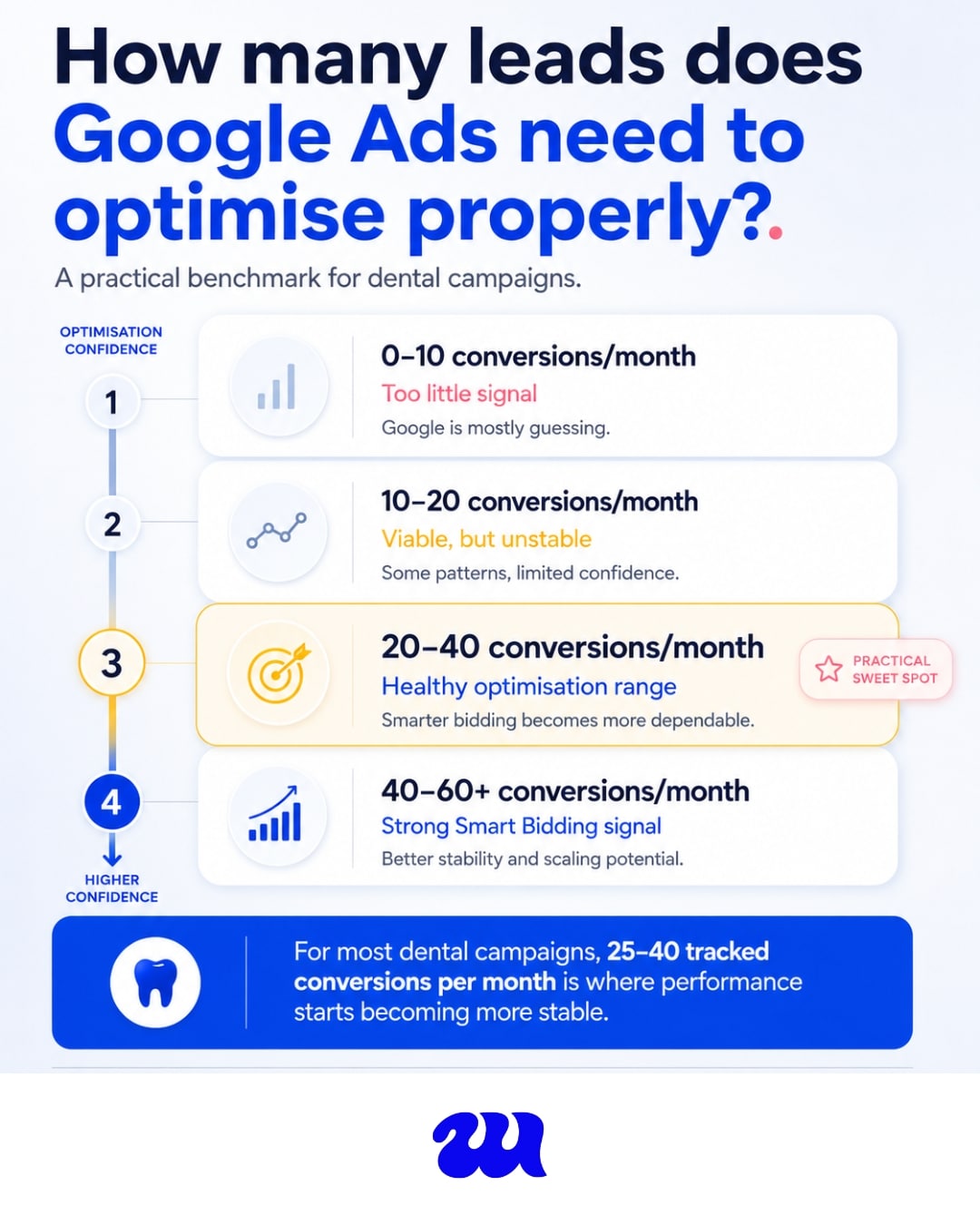
For dental practices running treatment-specific campaigns, the practical benchmarks break down like this:
| Conversions/Month | What Google Can Do | Status |
|---|---|---|
| 0–10 | Very limited. The algorithm is mostly guessing. Bidding decisions lack any real foundation. | Too little signal |
| 10–20 | Some patterns are forming. Bidding is becoming slightly more informed but remains unstable. | Viable but unstable |
| 20–40 | Smarter bidding becomes dependable. This is the practical sweet spot for most dental campaigns. | Healthy range |
| 40–60+ | Strong Smart Bidding signal. Better stability, clearer patterns and genuine scaling potential. | Strong signal |
This is one of the clearest reasons why budget matters so much. A campaign spending £1,000/month in a competitive dental market may never reach the conversion volume needed for Smart Bidding to work properly, not because the strategy is wrong, but because there simply isn't enough fuel in the engine to generate the data.
05.Volume Is Not the Goal. Quality Is.
This is one of the most important concepts for dental practice owners to understand: getting more leads into Google's system is not the same as getting better patients through your door. The two require different things.
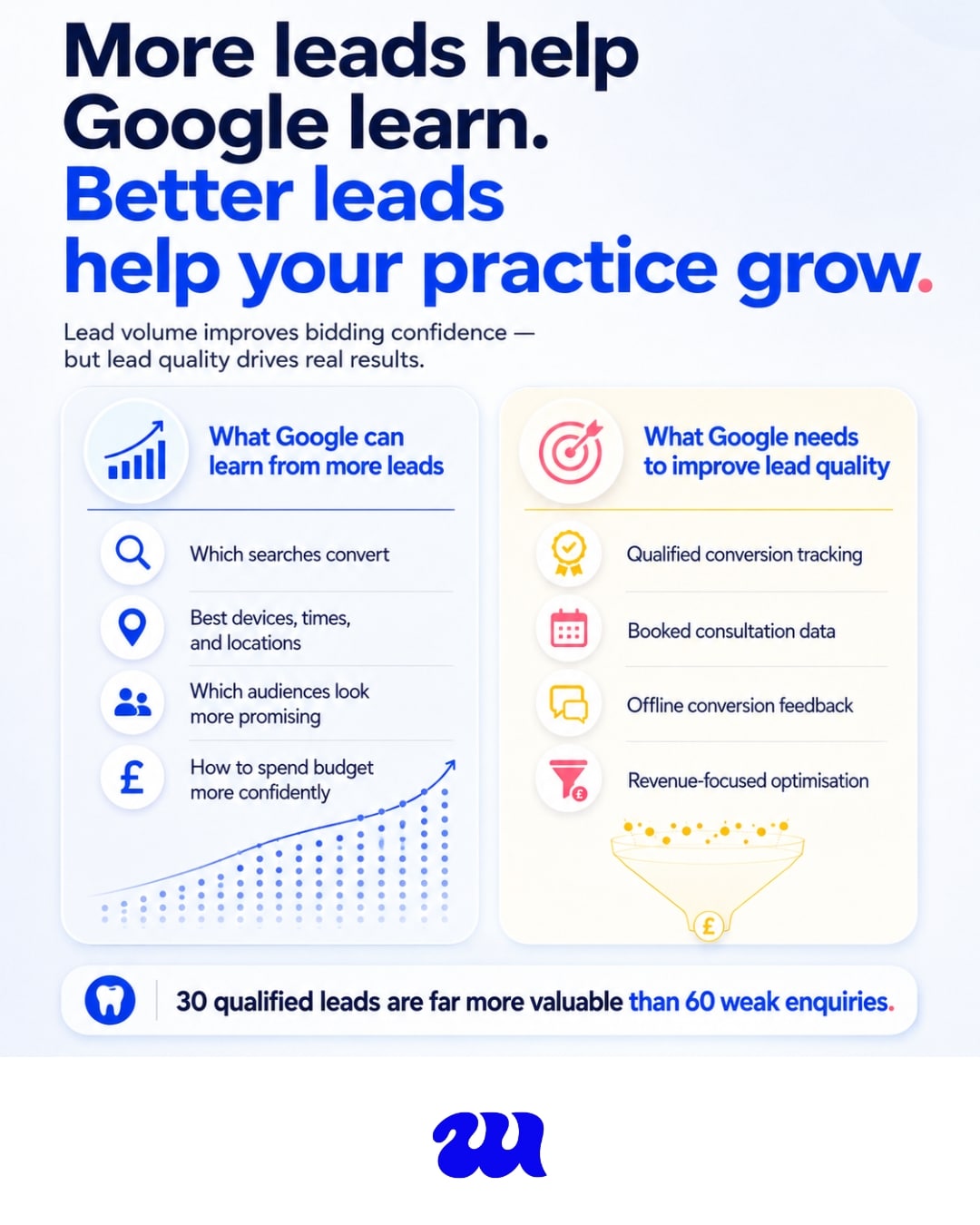
Lead volume helps Google learn patterns, which searches, devices, times and audiences tend to convert. But if what Google is learning from is a flood of low-quality enquiries, people calling to ask about NHS availability, price shoppers who never book, form submissions that go nowhere, then the algorithm will optimise toward generating more of exactly those.
What Google learns from more leads
- Which search terms convert
- Best devices, times and locations
- Which audience segments look promising
- How to spend your budget more confidently
What Google needs to improve lead quality
- Qualified conversion tracking
- Booked consultation data
- Offline conversion feedback
- Revenue-focused optimisation signals
The way to improve lead quality is not to tweak your ad copy, it's to connect your tracking more deeply to patient intent. That means:
- Tracking qualified calls separately, not just any call, but calls over 60–90 seconds that indicate a real conversation.
- Importing offline conversion data, if you're using practice management software or a CRM, you can feed booked appointment data back into Google Ads to tell the algorithm which of its leads actually turned into patients.
- Using goal-based conversion values, if an implant enquiry is worth significantly more than a hygiene enquiry, that difference should be reflected in your conversion setup so Google can bid accordingly.
- Excluding low-quality conversion events, form submissions that never result in a call shouldn't be counted with the same weight as a booked consultation.
"30 qualified leads are far more valuable than 60 weak enquiries and Google will learn whichever pattern you teach it."
Most dental campaigns running today are optimising toward the wrong goal. They're counting form fills when they should be counting booked consultations. They're tracking all calls when they should be tracking qualified calls. The result is a campaign that looks fine in the dashboard and disappoints in reality.
06.Why Lower Budgets Often Stall, And What "Enough" Actually Means
Budget is the lever that most dental practices are most reluctant to move. It's understandable, spend more on ads feels like more risk. But the relationship between budget and performance in Google Ads is not linear and that's critical to understand.
Below a certain budget threshold, a dental campaign simply cannot generate enough conversion data to leave the low-data zone. The algorithm stays in a state of perpetual guessing and the results are unstable, inefficient and often misleading month to month.

Here's how the math works in practice. For a typical dental treatment campaign in a competitive UK location, cost per lead ranges from £50–£150 depending on the treatment, location and how competitive the auction is. That range tells you the minimum budget you need to generate meaningful data:
At £2,500/month
- At £50 CPL, 50 leads/month
- At £75 CPL, 33 leads/month
- At £100 CPL, 25 leads/month
- At £125 CPL, 20 leads/month
- At £150 CPL, 16 leads/month
At £1,000/month
- At £75 CPL, 13 leads/month
- At £100 CPL, 10 leads/month
- At £125 CPL, 8 leads/month
- At £150 CPL, 6 leads/month
At £1,000/month, even at the most optimistic CPL, you're looking at 13 leads per month, well below the 25–40 range needed for Smart Bidding to operate with any real confidence. The campaign is technically running, but it's running at a disadvantage that no amount of ad copy testing or keyword refinement will fix.
For most priority dental treatment campaigns, implants, Invisalign, composite bonding, £2,500/month is a credible minimum starting point. Some practices in highly competitive locations (London, major city centres) will need more. Practices in lower-competition areas may be able to achieve results at slightly less. But £1,000/month campaigns targeting high-value treatments in competitive postcodes are fighting with one hand tied behind their back.
What About Return on Investment?
It's worth reframing the budget conversation around the value of a patient, not just the cost of a click. A single dental implant case in a UK practice typically generates £2,500–£4,500 in treatment revenue and that's before you account for the lifetime value of a retained patient who returns for hygiene, whitening and additional treatments over years.
If a campaign generating 20 qualified implant leads per month results in even 3–5 treatment starts, the return on £2,500 of ad spend is substantial. The goal isn't to minimise what you spend on ads. It's to maximise the efficiency with which that spend generates high-value patients and that requires enough budget for the machine to actually learn.
07.Budget Concentration Beats Budget Dilution, Every Time
One of the most counterintuitive truths in dental Google Ads is that running one well-funded campaign almost always outperforms running five underfunded ones. Yet the most common thing we see when auditing practice accounts is exactly this: a modest monthly budget split across every treatment they offer.
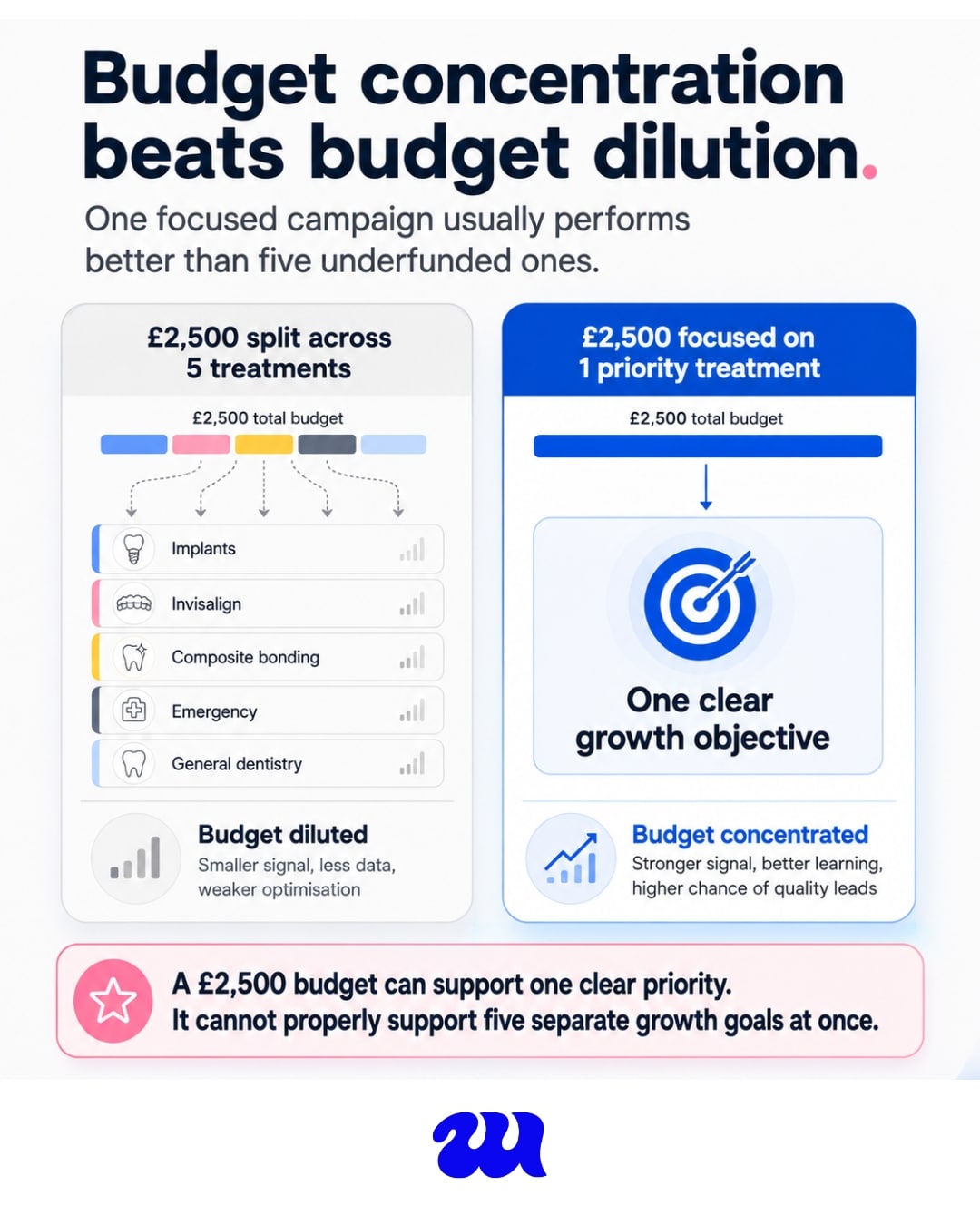
Imagine £2,500 split across five separate campaigns, implants, Invisalign, composite bonding, emergency and general dentistry. Each campaign receives £500/month. At even a modest £75 CPL, that's fewer than 7 leads per campaign per month. Every campaign sits in the low-data zone. None of them generate enough conversion signal for Google to optimise effectively. The result is five mediocre campaigns all competing for attention and none of them performing at their potential.
Now take that same £2,500 and concentrate it on your single highest-value priority, dental implants, for example. Suddenly you have a campaign with the budget to generate 20–30 leads per month, build real Smart Bidding signal, accumulate conversion data and start attracting the right patients with genuine efficiency.
A £2,500 budget can support one clear priority campaign with genuine optimisation potential. It cannot properly support five separate campaigns simultaneously. The math simply doesn't work and splitting budget dilutes signal, slows learning and produces weaker results across the board.
How to Decide Where to Concentrate
The right answer isn't always the most expensive treatment. The right priority campaign is determined by three things:
- Revenue per patient, which treatment generates the most value per successful conversion?
- Search demand in your area, is there sufficient local search volume to generate meaningful impressions and clicks?
- Your practice's competitive advantage, which treatments do you genuinely perform well, have strong reviews for and can convert enquiries into starts?
For most private or mixed practices, dental implants and Invisalign/clear aligners represent the strongest concentration candidates, high search volume, high patient value and high conversion intent. Once those campaigns are performing with stable data and consistent lead flow, secondary campaigns can be introduced and funded from the margin generated by the first.
08.Match Types Have Changed, Here's What That Means for Your Campaigns
If your Google Ads campaigns were built before 2024, there's a reasonable chance their keyword strategy is based on assumptions that are no longer accurate. The role of match types, Exact, Phrase and Broad, has changed fundamentally as Google has shifted toward AI-driven matching.
The short version: Google now interprets the meaning and intent behind a search rather than matching the literal words typed. An Exact Match keyword no longer means your ad only shows for that precise phrase, it means your ad shows for searches that Google determines share the same intent. Broad Match, paired with Smart Bidding, is now far more capable and less chaotic than it was three years ago.
What This Means in Practice
The old approach was to use tightly controlled Exact Match keyword lists, add Phrase Match for broader reach and avoid Broad Match entirely to prevent irrelevant spend. That approach made sense when Google's matching was literal and Smart Bidding was immature. In 2026, it's not only outdated, it can actually limit your campaign's reach in ways that hurt performance.
Old Match Type Approach
- Heavy reliance on Exact Match
- Phrase Match for controlled reach
- Broad Match avoided entirely
- Large negative keyword lists as primary control
- Manual CPC bidding for granular control
Modern Approach (2026)
- Broad Match paired with Smart Bidding
- Intent-based matching across all types
- Negative keywords still essential
- Conversion quality as the primary signal
- AI Max for eligible campaigns
This doesn't mean abandoning structure entirely, it means shifting where control comes from. In a well-run 2026 dental campaign, control comes from your conversion quality signals (what you tell Google a good lead looks like), your negative keyword strategy and your campaign/ad group theme focus, not from trying to restrict every possible keyword variation.
AI Max: What Dental Practices Need to Know
Google has introduced AI Max for Search campaigns, a feature that uses AI to expand reach beyond your keyword lists by matching to high-intent queries that your keywords might not explicitly cover. Dynamic Search Ads are being upgraded into AI Max during 2026, with migration completing in Q3.
For dental practices, the key question with AI Max is always: does it bring in the right patients, or does it waste spend on irrelevant queries? The answer depends almost entirely on the quality of your negative keyword strategy and how well your conversion tracking reflects genuine patient intent. With those foundations in place, AI Max can materially increase qualified reach. Without them, it can drain budget on irrelevant traffic.
If your account contains Dynamic Search Ads campaigns, these will be automatically upgraded to AI Max by Google. Review your current DSA setup, ensure your negative keyword lists are comprehensive and confirm your conversion tracking is correctly configured before this happens, or contact your PPC manager to do this on your behalf.
09.What a Well-Structured Dental Campaign Looks Like, And What to Do Next
Putting everything in this guide together, here's what a properly structured dental Google Ads account looks like in 2026 and the practical steps you or your agency should be taking right now.
Audit your conversion tracking
Is Google counting the right things? If form fills and unqualified calls are being counted with the same weight as booked consultations, your campaign is optimising toward the wrong goal. Fix this first, everything else depends on it.
Choose one priority treatment and concentrate budget
Identify your highest-value treatment with meaningful local search demand. Concentrate your budget there until that campaign is generating 25–40 conversions/month consistently. Do not launch additional campaigns until the first one is performing stably.
Set a realistic minimum budget
For most treatment campaigns in competitive UK locations, £2,500/month is the minimum that gives Smart Bidding enough data to function properly. If your current budget is below this, consider whether it's worth running the campaign at all, or whether consolidating to a higher single budget would produce better results.
Review your match type structure
If your campaigns were built pre-2024, they likely need restructuring. Modern campaigns should use Broad Match with Smart Bidding as the core strategy, with tightly maintained negative keyword lists and intent-based ad group organisation rather than rigid exact-match control.
Set up offline conversion import
If you use any kind of practice management software or CRM, work with your agency to import booked appointment and treatment start data back into Google Ads. This single change, feeding Google real revenue signal rather than just form fills, can meaningfully improve lead quality over 60–90 days.
Resist reactive changes during the learning phase
Once your campaign is live and properly set up, give it 60–90 days before making structural changes. Monitor spend and lead quality weekly, but don't adjust bid strategies, budgets, or conversion goals based on 2–3 weeks of data. The algorithm needs time and interrupting it resets the clock.
Address DSA / AI Max migration
If you run Dynamic Search Ads, get ahead of the September 2026 upgrade to AI Max. Review your current setup, update negative keywords and make sure conversion tracking is solid before the automatic migration happens.
10.Frequently Asked Questions
Google's official learning phase is typically 1–2 weeks after a significant change, but for a new dental campaign to genuinely stabilise, meaning consistent lead volume, predictable cost per lead and a Smart Bidding algorithm that's making confident decisions, allow 60–90 days. The 2-week learning phase refers to the algorithm's initial calibration. Real stability requires that period plus enough conversion data accumulation. If you're told a campaign is fully optimised after 3 weeks, that's a flag.
It's not unusual, but it is a problem. At 8 leads/month, you're operating well below the conversion volume Smart Bidding needs to function properly, which means Google is effectively guessing rather than learning. The maths are simple: if your CPL is £150 (common for dental implant campaigns in competitive areas), a £1,200 budget can only ever generate 8 leads per month. At that level, the algorithm can't optimise and results will remain unstable. The options are to increase budget to give the campaign what it needs, or to consolidate spend away from low-performing campaigns into a single priority one.
Almost certainly not, unless your total budget is high enough to fund each one properly. If your total monthly spend is £5,000 or less, spreading it across multiple treatment campaigns will leave each one data-starved and underperforming. The right approach is to identify your single most valuable treatment, concentrate the majority of your budget there, build that campaign to consistent performance and then gradually introduce secondary campaigns as budget allows and results justify. Budget dilution is one of the most common and costly mistakes we see in dental Google Ads accounts.
In Google Ads terminology, a conversion is any action you've defined as valuable and are tracking, a phone call, a form submission, a chat message, or a booked appointment. A lead in the real sense is someone who has genuinely expressed interest in a treatment and has realistic intent to book. The problem is that many dental campaigns count all conversions equally, so a 10-second call that went to voicemail counts the same as a 4-minute call where someone asked detailed questions about implant costs. Improving the quality of your conversion definition, tracking only genuinely meaningful actions, is one of the highest-leverage changes you can make to a dental campaign.
Expect a reset. When a campaign is paused for an extended period, Google's bidding model loses its recency signal and effectively needs to relearn. This doesn't mean all your historical data is lost, the algorithm will still have access to older conversion patterns, but recent data is weighted more heavily, so a two-month gap will cause performance instability when you resume. Budget for a 4–8 week recovery period, avoid making structural changes during that time and resist the temptation to turn the campaign back off if the first few weeks look weak. Consistency is what the algorithm rewards most.
Broad Match tells Google to show your ad for searches that share the intent behind your keyword, not just the literal words. Five years ago, Broad Match on a dental campaign was risky because it would match irrelevant queries and waste budget. Today, when paired with Smart Bidding and a well-maintained negative keyword list, Broad Match is a legitimate and often highly effective strategy. It allows Google to find high-intent patients you wouldn't have captured with a tight Exact Match approach. That said, it requires strong negative keywords and robust conversion tracking to prevent irrelevant spend, if those foundations aren't in place, Broad Match can do more harm than good.
AI Max is Google's next-generation campaign feature that extends your reach beyond your keyword lists by matching to high-intent searches using AI. For dental campaigns, it's particularly relevant if you're currently running Dynamic Search Ads, these are being automatically upgraded to AI Max during 2026, with migration expected to complete by Q3. If you have DSA campaigns, you should review them now: check your negative keyword lists are comprehensive, confirm your conversion tracking is solid and consider whether to opt in proactively (which allows you to configure settings) rather than being migrated automatically. Ask your agency to audit any DSA campaigns in your account before September.
A few indicators: Are they tracking the right conversions, qualified calls and booked consultations, not just any click-to-call or form fill? Can they explain your cost per lead by treatment type and how it's trending? Do they give you a clear recommendation on budget based on your local market's CPL, rather than just running whatever you give them? Are they making changes to the account with clear reasoning, or are changes unexplained? Are they talking about lead quality and offline conversion data, or just impressions, clicks and CTR? A good agency should be able to tell you what each pound of spend is delivering in patient enquiries and have a clear view on how to improve that over time.
It's complicated. NHS dental search demand is enormous, but the conversion economics rarely support paid search. NHS treatment fees are capped, meaning there isn't sufficient revenue per patient to justify a cost per lead of £50–£150+. If you run a mixed practice and are looking to grow your private list, Google Ads can absolutely work for the private treatments, but the campaign needs to be specifically designed to attract private patients and exclude NHS-only searches (which requires careful negative keyword management). Running a Google Ads campaign aimed at NHS patients without this distinction will almost always produce a negative return on investment.
What an ideal Google Ads budget actually looks like.
Most dental practices do not lose money on Google Ads because the budget is small. They lose money because it is split too thinly across too many treatments.
Google needs enough clean conversion signal in each campaign to make sensible decisions. So the structure has to be simpler, tighter and more deliberate than most older dental accounts are built to be.
At £5,000/month, focus beats coverage.
This is the first level where a practice can usually support a proper general dentistry campaign and one focused high-value treatment campaign.
Recommended campaign structure
Learning strength
Strong enough to support two focused campaigns, as long as tracking and lead handling are clean.
Good signal potential
Best use
Build a stable general dentistry campaign, then add one high-value treatment such as implants, Invisalign or composite bonding based on margin and demand.
What to avoid
Do not split £5,000 across four or five treatment campaigns. That usually creates several weak campaigns instead of two that can actually learn.
Treatment focus
Not sure which structure fits your practice?
We will look at your current budget, conversion volume and treatment margins, then tell you how we would structure the account.
08.The Wise ROI Calculator
The real question is not just whether you can afford to spend more. It is what you get back if you do. Use the calculator below to model your numbers, ad spend, CPC, treatment fee, your actual costs and see the full picture from click to converted patient.
What does your ad spend actually return?
Built around real UK dental practice economics. Enter your numbers and see the full picture from click to converted patient, gross revenue, net profit, break-even and true ROAS.
- Google Marketing Live 2026, Official Google Blog, May 20, 2026, blog.google/products/ads-commerce/google-marketing-live-2026-collection/
- Google Ads Match Types Documentation, support.google.com, support.google.com/google-ads/answer/7478529
- Google Smart Bidding & Learning Phase, Google Ads Help Centre, support.google.com/google-ads/answer/6268632
- Dynamic Search Ads Upgrading to AI Max, Google Ads & Commerce Blog, April 15, 2026, Brandon Ervin, Director of Product Management, blog.google/products/ads-commerce/dsa-upgrade-to-ai-max-2026/
- AI Max for Search Campaigns, Open Beta Launch, Google Ads Developer Blog, May 6, 2025, ads-developers.googleblog.com
- Google Ads Broad Match Default, Search Engine Land, July 2024, searchengineland.com
- Google Marketing Live 2026 Full Recap, PPC Land, May 20, 2026, ppc.land
- AI Max Out of Beta, Marketing Dive, April 16, 2026, marketingdive.com