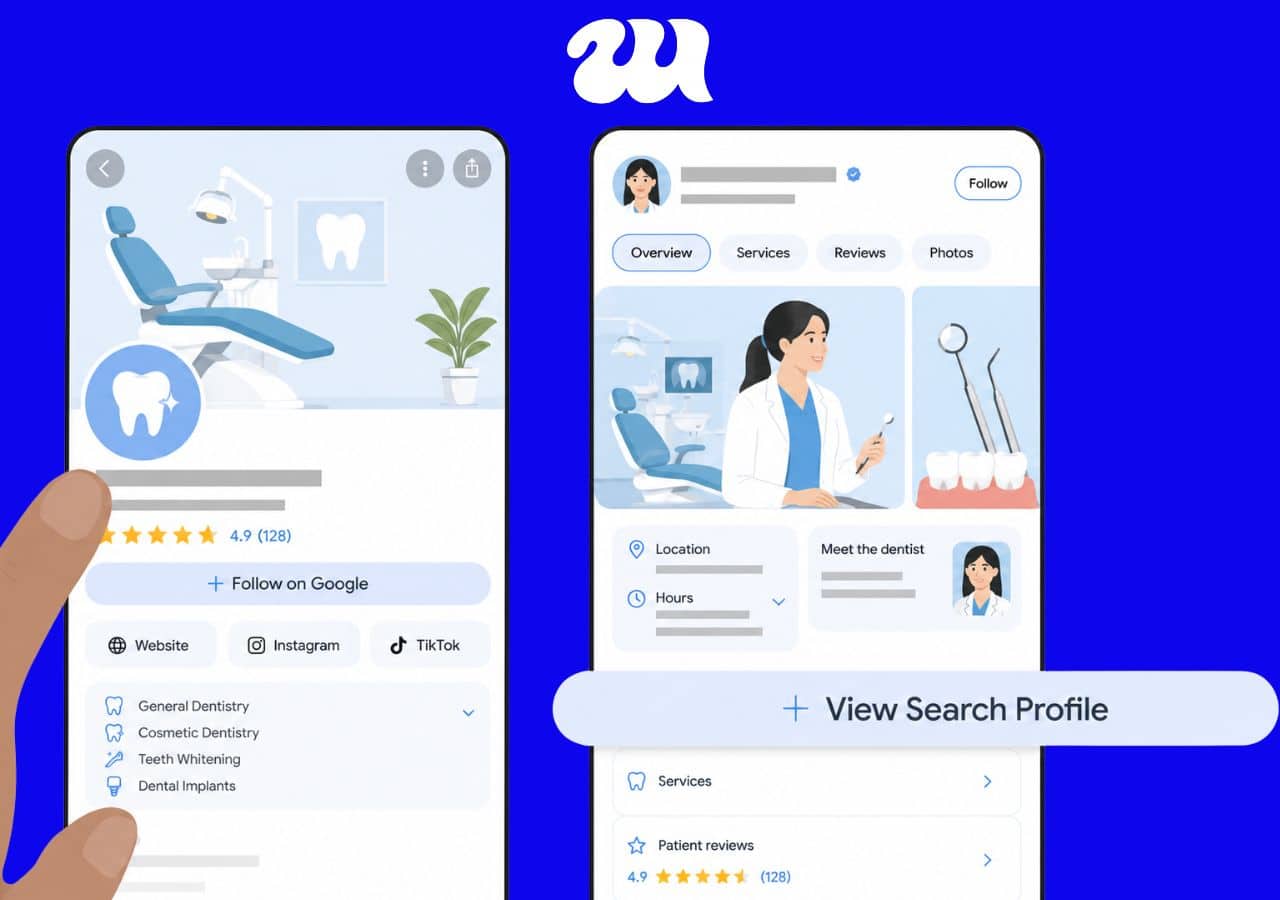
Google has announced Search profiles, a new feature designed to give publishers and creators a dedicated, shareable space on Search. These profiles can bring together content from websites, social platforms and video platforms, helping people find accurate and up-to-date information about a source.
At Wise Agency, we see this as part of a bigger shift. Search is not just about pages anymore. It is about entities, authors, brands, expertise, content ecosystems and whether Google can clearly understand who is behind the information.
For UK dental practices, this matters. Patients are not only comparing treatment pages. They are checking reviews, social proof, videos, clinician credibility, Google Business Profiles and how consistently a practice shows up across the web.
01.What are Google Search profiles?
Search profiles are dedicated profile spaces for eligible publishers and creators. Google says they can highlight latest articles, videos and social posts, allow people to follow sources, and make content more likely to appear in Discover.
Profiles can be accessed on mobile through a creator or publisher knowledge panel, by tapping a source name on Discover, or through a direct URL. To start, Google says eligible publishers and creators need a sizeable following on at least one major social or video platform.
02.Why Google is moving towards stronger source identity
Google Search has been changing quickly. AI results, Discover, knowledge panels, social content and traditional organic listings are all becoming more connected. Search profiles give Google another way to organise content around trusted sources rather than isolated pages.
For users, this can make it easier to follow a trusted creator or publisher. For brands, it creates a more visible identity layer on Search. For dental practices, the lesson is simple: your online presence needs to be joined up.
- Google needs clarity: It should be obvious who the practice is, where it is based and what treatments it provides.
- Patients need confidence: They want to know the people, results and reputation behind the website.
- Content needs consistency: Website, Google Business Profile, social media and video content should all tell the same story.
- Expertise needs proof: Clinical credentials, experience, reviews and case evidence should be easy to find.
03.What this means for dentists
Most UK dentists will not be claiming a Search profile today. Google says the feature is initially launching in the US for publishers and creators, so this should not be positioned as something every UK practice can claim now. But Google also says it plans to expand Search profiles to more publishers and creators around the world. That is the important part for UK dentistry. The practices that wait until the rollout reaches them may already be behind competitors that have spent months building stronger profiles, clearer content and better multi-platform trust signals.
For dentists, the future of search is likely to reward practices that are clear, consistent and trustworthy across multiple surfaces.
Dental practices should think beyond the website
Your website remains the centre of your dental SEO strategy, but it should not be the only place where expertise exists. Treatment explainers, patient FAQs, clinician videos, social proof and educational content all help build a clearer picture of the practice.
Clinicians are becoming part of the search signal
Patients often search around people as much as practices. They want to know who will provide Invisalign, implants, composite bonding or cosmetic consultations. Strong clinician bios, professional profiles and consistent author signals can help build trust.
Video and social content matter more
Google specifically mentions latest articles, videos and social posts in the Search profiles announcement. Dental practices that publish helpful videos, treatment explainers and patient education content are building assets that may become more valuable as Search becomes more multi-platform.
Search is bigger than rankings.
Wise helps dental practices build visibility across organic search, local search, content, reviews and conversion-focused websites.
WhatsApp Us →04.How this could affect dentistry
Dentistry is a trust-led sector. Patients are making decisions about health, appearance, cost and long-term care. That means Google has every reason to care about the credibility of the source behind dental information.
Search profiles may not be built for dental practices today, but the same principles apply to dental SEO and dental content strategy.
- Practices with strong brands may stand out more: A clear, recognisable practice identity helps patients remember and trust you.
- Educational content may become more important: Helpful treatment guides, videos and FAQs give Google and patients more context.
- Clinician expertise should be visible: Dental content should be connected to qualified people, not faceless copy.
- Google Business Profile needs to stay accurate: Opening hours, services, photos, reviews and practice details all support trust.
- Social proof should be consistent: Reviews, case studies, before-and-after content and patient stories should align across platforms.
05.What dental practices should do now
The practical response is not to wait for Search profiles to launch in the UK. It is to strengthen the signals Google already uses to understand your practice, so you are not starting from zero when source-led profiles and richer search features become more widely available.
| Area | Why It Matters | What To Improve |
|---|---|---|
| Google Business Profile | It is often the first source patients see in local search. | Keep services, photos, opening hours, reviews and descriptions up to date. |
| Website treatment pages | Google needs clear treatment-specific relevance. | Create detailed pages for Invisalign, implants, bonding, whitening, hygiene and emergency care. |
| Clinician profiles | Patients trust people, not just practice names. | Add bios, qualifications, experience, treatment focus and professional photos. |
| Author signals | Dental content needs clear expertise behind it. | Attach blogs and treatment guides to relevant clinicians or the practice team. |
| Social and video content | Google is increasingly connecting content across platforms. | Publish useful explainers, FAQs, practice updates and short treatment education videos. |
| Schema markup | Structured data helps search engines understand entities and content. | Use organisation, local business, dentist, FAQ and article schema where appropriate. |
| Reviews and proof | Dental decisions depend heavily on reassurance. | Show reviews, case studies, testimonials and before-and-after galleries clearly. |
| Brand consistency | Inconsistent names, links and bios create confusion. | Use the same practice name, website, contact details and positioning across platforms. |
06.The Wise view: this is a warning shot for lazy dental SEO
For years, dental SEO has been treated too narrowly: keywords, blogs, backlinks and a bit of technical work. Those still matter, but they are not enough on their own.
Google’s Search profiles announcement points towards a search environment where the source behind content matters more. For dental practices, that means the strongest brands will be the ones with clear expertise, joined-up content, accurate local data and visible proof. It may be US-only for now, but UK practices should treat this as an early warning: do the groundwork before the rollout reaches your market, not after.
The practices that win will not just be the ones publishing the most. They will be the ones Google and patients can understand fastest.
Our recommendation for dental practices
- Audit your Google Business Profile and make sure it reflects the practice accurately.
- Review every treatment page and check whether it answers real patient questions.
- Strengthen clinician bios and connect expertise to key treatments.
- Create useful social and video content that supports your main treatment priorities.
- Keep your brand, wording and links consistent across every platform.
- Use schema and internal linking to help Google understand your practice ecosystem.
Search profiles may be new, but the principle behind them is not: clear sources win trust. In dentistry, trust is the entire game. UK practices that build that trust now are less likely to be left behind when Google expands these profile-led search experiences beyond the US.
07.FAQs About Google Search Profiles and Dentistry
What are Google Search profiles?
They are dedicated, shareable profile spaces that allow eligible publishers and creators to highlight content from articles, videos and social platforms on Google Search.
Can UK dental practices claim a Search profile now?
Not currently based on Google’s announcement. Search profiles are initially launching in the US and are aimed at publishers and creators with sizeable followings on major social or video platforms.
Why does this matter for dentists?
It shows that Google is putting more emphasis on source identity, trust and cross-platform content. Dentists should make sure their website, Google Business Profile, social profiles and video content all support the same clear practice identity.
Will Search profiles replace dental SEO?
No. Dental SEO still needs strong treatment pages, technical foundations, local relevance, reviews, content and conversion strategy. Search profiles simply show that source authority is becoming more visible in Search.
What should a dental practice do first?
Start with the basics: update your Google Business Profile, improve key treatment pages, strengthen clinician bios, publish helpful patient content and make sure your practice details are consistent everywhere.
Ready to build a stronger dental search presence?
Wise helps UK dental practices prepare for the next stage of search with stronger websites, clearer content, local SEO, schema, Google Business Profile optimisation, dental social media and conversion-focused marketing.