AI search is changing how patients discover, compare and choose dental practices.
For years, dental SEO was mainly about ranking on Google.
If your practice appeared near the top for searches like “dentist near me”, “Invisalign Leicester”, “dental implants Nottingham” or “composite bonding Birmingham”, you had a strong chance of winning the enquiry.
That still matters.
But it is no longer the full picture.
Patients are now using AI-powered platforms to ask more complex, trust-led questions.
They are not only typing short keywords into Google. They are asking ChatGPT, Gemini, Perplexity and Google’s AI results for advice, comparisons and recommendations.
Questions like:
“Who is the best Invisalign dentist near me?”
“What should I look for in a dental implant clinic?”
“Is composite bonding worth it?”
“Which dental practice is best for nervous patients?”
“What is the difference between Invisalign and fixed braces?”
“Which cosmetic dentist should I choose in Leicester?”
This is where AI search changes the game.
A recent Ahrefs analysis looked at over 1 billion data points across 14 studies into AI search behaviour. The findings were clear: AI search does not simply reward technical optimisation. It rewards brands that are known, trusted, cited and mentioned.
For dental practices, that is a major shift.
The future of dental SEO is not just about ranking.
It is about becoming the obvious practice to recommend.
01.What Is AI Search SEO in Dentistry?
AI search SEO in dentistry is the process of helping a dental practice become visible and trusted across AI-powered search platforms.
That includes platforms and search experiences such as:
ChatGPT.
Google AI Overviews.
Google AI Mode.
Gemini.
Perplexity.
Microsoft Copilot.
Voice search.
AI-assisted search tools.
Traditional dental SEO focuses heavily on ranking pages in search engines.
AI search SEO goes further.
It asks:
Is your practice known for the treatments you want to attract?
Is your website clear enough for AI systems to understand?
Do other websites mention your practice?
Do patients review you consistently?
Do you have useful treatment content?
Are your clinicians visible?
Are you creating video content?
Are you being talked about outside your own website?
Do you have authority in your local area?
This is why AI search is not simply “SEO with a new name”.
It is a reputation layer.
AI systems are trying to answer patient questions with confidence. To do that, they need clear, repeated signals that your practice is credible.
02.The Big Lesson: AI Search Rewards Being Known
One of the strongest takeaways from the Ahrefs research is this:
AI search does not reward brands that only optimise.
It rewards brands that are already known.
That should be a wake-up call for dental practices.
For years, many clinics have treated SEO as a technical checklist.
Add keywords.
Write service pages.
Add schema.
Get a few backlinks.
Build location pages.
Wait for rankings.
That approach is no longer enough.
AI search is less interested in whether your page has been “SEO’d” perfectly and more interested in whether your practice is worth mentioning.
This means the practices most likely to benefit from AI search will be the ones with strong authority signals across the wider web.
Not just on their own website.
Across reviews, videos, local mentions, treatment content, social proof, directories, comparison pages, educational content and brand searches.
In simple terms:
If patients, publishers and platforms already associate your practice with a treatment or location, AI tools are more likely to do the same.
03.Why This Matters for Dental Practices
Dental care is a high-trust decision.
Patients do not choose a dentist the same way they choose a cheap product on Amazon.
They are making decisions about their health, appearance, confidence, finances and sometimes long-term treatment plans.
That makes trust critical.
A patient considering dental implants may want to know:
Who has experience?
Who explains the risks clearly?
Who has strong reviews?
Who offers finance?
Who has before-and-after examples?
Who feels safe?
Who is local?
Who seems credible?
A patient considering Invisalign may ask:
Which dentist is good for adult teeth straightening?
How much does Invisalign cost?
Is Invisalign better than fixed braces?
How long does treatment take?
Which practice offers consultations?
Can I trust the results?
These are not simple searches.
They are decision-making journeys.
AI search is designed to summarise, compare and recommend.
That means your dental practice needs to show up as a trusted answer, not just a blue link.
Need your dental SEO strategy to work beyond Google?
Wise helps dental practices build faster websites, stronger treatment content, better local authority and patient journeys designed for the next phase of search.
Explore Dental SEO →04.Finding 1: “Best X” Content Is Extremely Important
One of the standout findings from the Ahrefs analysis was that “Best X” blog listicles are the single most prominent content format cited by AI chatbots.
For ChatGPT specifically, they reportedly made up 43.8% of all cited page types.
That matters for dentistry because patients often think in comparison-led terms.
They search for:
Best dentist near me.
Best Invisalign dentist.
Best cosmetic dentist.
Best dental implant clinic.
Best teeth whitening treatment.
Best private dentist.
Best dentist for nervous patients.
Best orthodontic option for adults.
The issue is that many dental practices avoid this type of content because it feels too direct or competitive.
But “best” content does not need to be spammy.
It can be genuinely useful.
For example, a dental practice could publish:
“How To Choose the Best Cosmetic Dentist for Your Smile Makeover”
“What Makes a Good Dental Implant Clinic?”
“Best Teeth Straightening Options for Adults”
“Invisalign vs Braces: Which Is Best for You?”
“How To Choose a Private Dentist in Leicester”
“What To Look for in a Dentist if You Are Nervous”
This type of content helps patients make better decisions.
It also gives AI systems useful context.
The goal is not to write fake “top 10 dentists” articles.
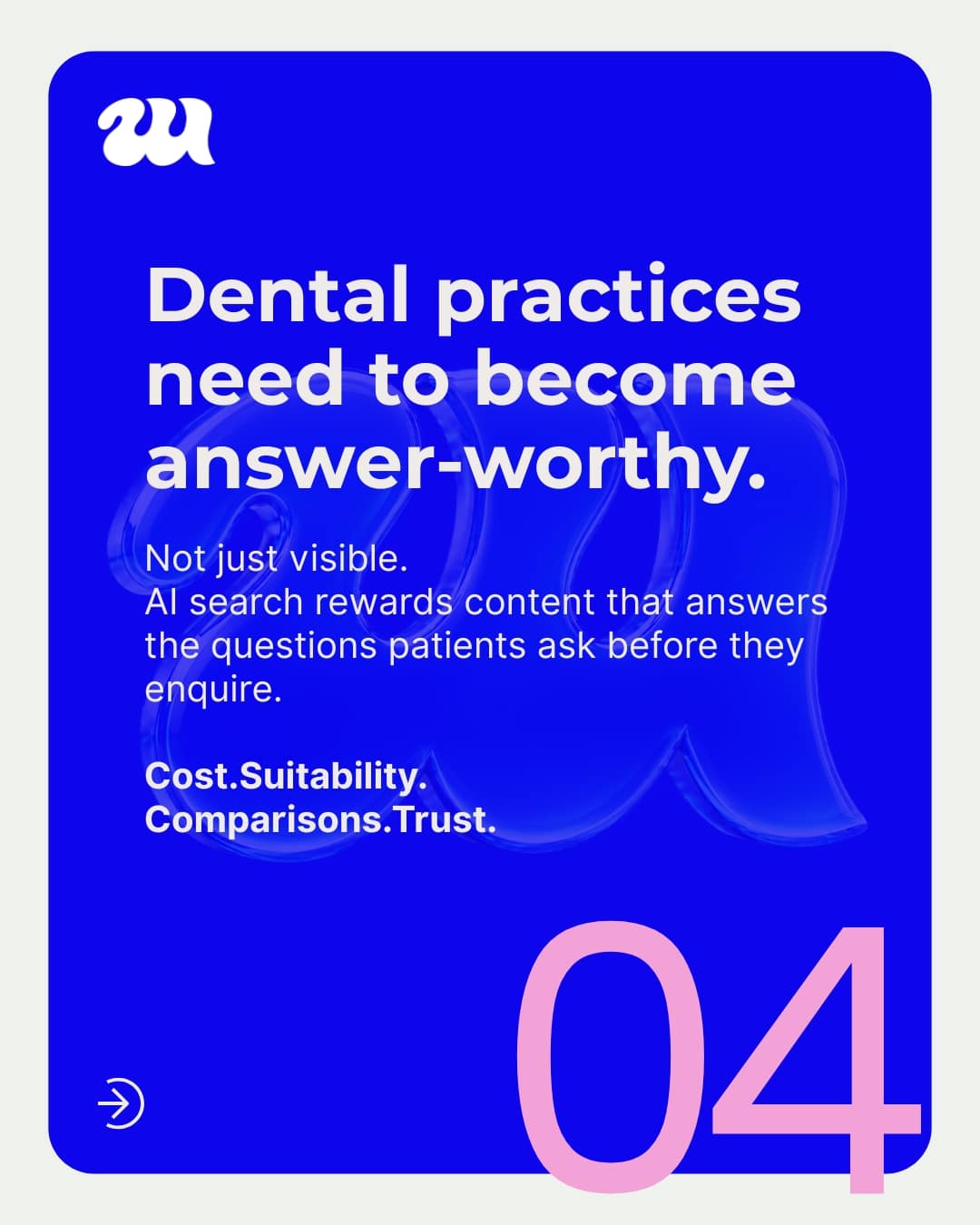
The goal is to create decision-stage content that answers the questions patients ask before they enquire.
05.Finding 2: Many AI Citations Come From Sources You Cannot Fully Control
Another important finding was that 67% of ChatGPT’s top 1,000 citations came from sources marketers cannot easily influence.
These included sources such as Wikipedia, homepages and app stores.
Only 32.3% were considered more influenceable content types, such as educational pages, reviews, news articles and blog posts.
For dental practices, this has a clear lesson.
You cannot fully control AI search.
You can influence it, but you cannot own every signal.
That means your strategy needs to go beyond your own website.
A strong AI search strategy for a dental practice should include:
A clear, fast, well-structured website.
High-quality treatment pages.
Strong Google Business Profile optimisation.
Consistent Google reviews.
Mentions on local websites.
Dental directory listings.
Local PR.
YouTube videos.
Helpful blog content.
Patient case studies.
Social media proof.
Consistent practice information across the web.
Third-party authority matters.
If your practice only talks about itself on its own website, the signal is weaker.
If patients, local publications, directories, review platforms and video platforms also mention you, the signal becomes stronger.
06.Finding 3: AI Search Has A Separate Discovery Layer
One of the most interesting Ahrefs findings was that 28.3% of ChatGPT’s most-cited pages had zero Google organic visibility.
In other words, some pages were cited repeatedly by ChatGPT even though they did not rank in Google.
This suggests that AI search has a separate discovery layer.
That does not mean Google rankings are irrelevant.
They are still very important.
But it does mean traditional rankings are not the only route to visibility.
For dental practices, this creates both a risk and an opportunity.
The risk is that ranking well in Google may not guarantee visibility in AI-generated answers.
The opportunity is that useful, trusted, specific content may still influence AI search even if it is not ranking in position one.
That is especially important for dental practices in competitive locations.
If you are a private dental practice competing against large groups, directories and aggregator sites, you may struggle to rank for every high-value keyword.
But you can still build topical authority around:
Your treatments.
Your clinicians.
Your patient experience.
Your local area.
Your case studies.
Your pricing explanations.
Your approach to care.
Your niche strengths.
AI search may reward that clarity in ways traditional search does not always show immediately.
07.Finding 4: Being Retrieved and Being Cited Are Different
The Ahrefs analysis also found that ChatGPT only cites around 50% of the URLs it retrieves.
That means AI tools may fetch and process many pages, but only show some of them as visible citations.
This distinction matters.
A dental practice may influence an AI-generated answer without being visibly cited.
For example, your Invisalign page, implant guide or nervous patient article might help shape the answer, even if the AI tool cites another source.
This changes how practices should measure success.
Traditional SEO is easier to track:
Rankings.
Clicks.
Impressions.
Traffic.
Form submissions.
Calls.
AI search is messier.
Your practice may be influencing awareness before the patient ever clicks.
A patient might read an AI-generated answer, see your practice mentioned, then search your brand name later.
Or they may not see your practice cited, but AI-assisted research may still shape their treatment decision.
This is why brand search, direct traffic, review growth and consultation quality will become more important measurement signals.
Dental SEO reporting needs to evolve.
08.Finding 5: Schema Is Not A Magic AI Search Hack
Ahrefs found that adding schema markup had no meaningful impact on AI citations.
That is important because schema is often sold as a shortcut.
To be clear, schema is still useful.
Dental practices should still use structured data where appropriate.
That may include:
LocalBusiness schema.
Dentist schema.
Organisation schema.
FAQ schema.
Review schema where compliant.
Breadcrumb schema.
Article schema.
Service schema.
But schema alone will not make a practice visible in AI search.
It helps machines understand your content.
It does not make your practice authoritative.
A weak practice website with thin content, poor reviews and no external mentions will not suddenly become an AI search winner because schema has been added.
The foundation still matters more.
Useful content.
Clear service pages.
Strong reviews.
Local authority.
Fast website performance.
Good user experience.
Consistent brand signals.
Real-world trust.
Schema supports the strategy.
It is not the strategy.
09.Finding 6: YouTube Mentions Strongly Correlate With AI Brand Visibility
One of the most valuable findings from the Ahrefs research was that YouTube mentions had the highest correlation with AI brand visibility.
That should get every dental practice owner’s attention.
Most dental practices still underuse video.
Some post the occasional Instagram reel.
Some upload a practice walkthrough once every few years.
Very few build a serious video content library.
That is a missed opportunity.
Dentistry is perfectly suited to video because patients want reassurance.
They want to see the dentist.
They want to hear explanations.
They want to understand the process.
They want to know whether they will feel comfortable.
They want to see real results.
Video can help answer questions like:
Does Invisalign hurt?
How long do dental implants take?
Is composite bonding reversible?
What happens at a consultation?
How much does teeth whitening cost?
Am I too nervous for treatment?
What if I have missing teeth?
How do I choose the right cosmetic dentist?
A strong dental YouTube strategy does not need to be complicated.
Start with the questions patients already ask every day.
Then turn them into short, clear videos.
Examples:
“Dental Implants Explained in 3 Minutes”
“Invisalign vs Braces: Which Is Right for You?”
“5 Things To Know Before Composite Bonding”
“What Happens at a Smile Makeover Consultation?”
“Are You Nervous About the Dentist? Here Is What We Do Differently”
“How Much Does Invisalign Cost?”
“What Makes a Good Candidate for Dental Implants?”
These videos can then be repurposed into:
Website embeds.
Blog content.
Short-form social clips.
Email content.
Google Business Profile updates.
FAQ sections.
Consultation follow-up resources.
AI search rewards brands that are mentioned and understood across multiple platforms.
YouTube helps build that visibility.
10.Finding 7: AI Overviews Can Reduce Clicks
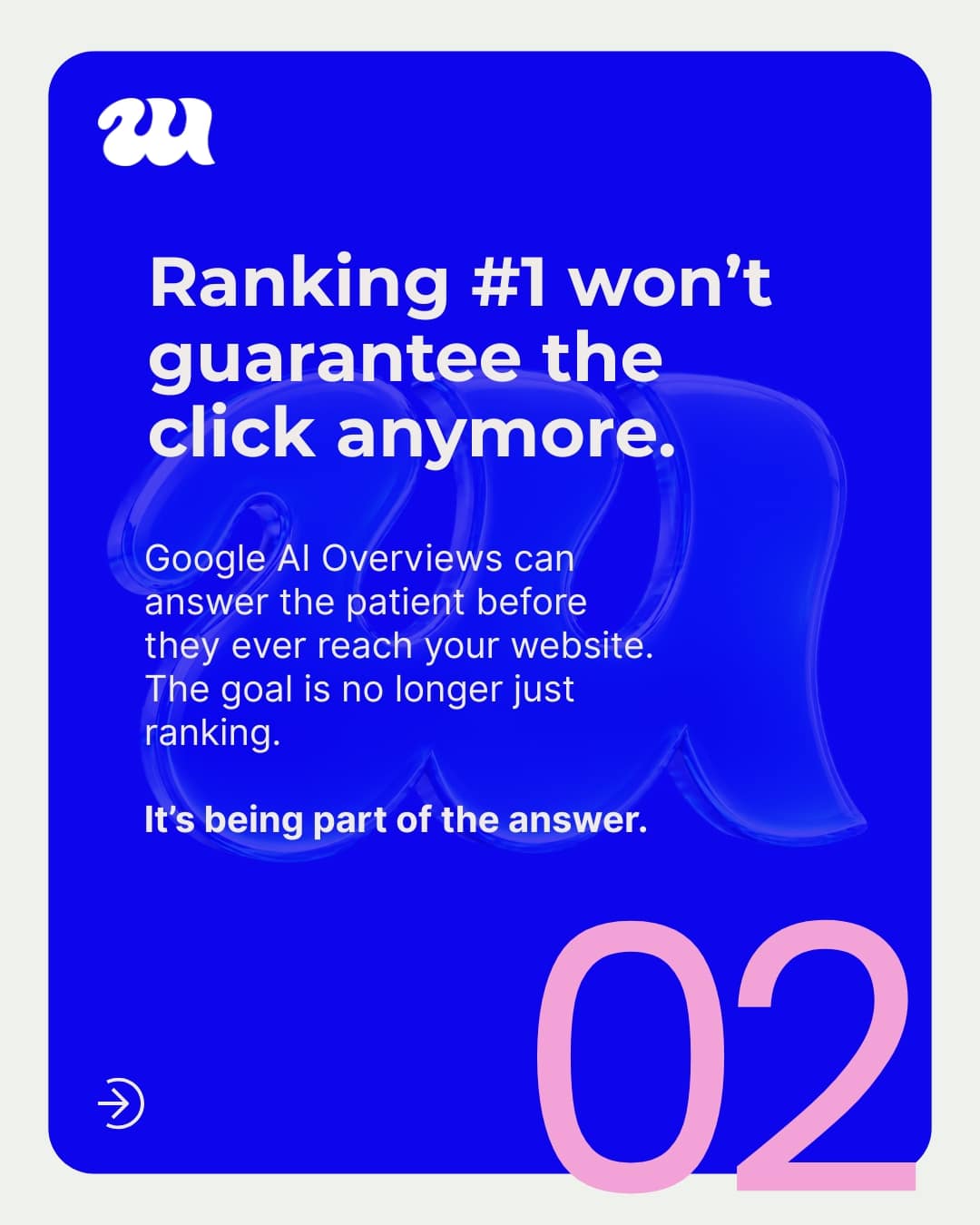
Another major finding was that AI Overviews reduce clicks to the number one result by 58%.
That means even if your practice ranks first, fewer people may click through if Google answers the query directly on the results page.
For dental practices, this is significant.
Many informational searches may become zero-click or low-click journeys.
For example:
“How long does Invisalign take?”
“Is composite bonding painful?”
“What is a dental implant?”
“How much does teeth whitening cost?”
“Can nervous patients be sedated?”
Google may answer these questions directly using AI Overviews.
That means the old model of “publish information, get clicks, convert visitors” may become less reliable.
But this does not mean content is pointless.
It means the role of content is changing.
Your content needs to:
Influence the answer.
Build brand visibility.
Earn trust before the click.
Create recognition.
Support later branded searches.
Help patients choose you when they are ready.
If a patient sees your practice repeatedly across AI answers, YouTube, reviews, social content and local search, you have a better chance of being remembered.
The click may come later.
The impression starts earlier.
11.Finding 8: AI Overviews Mostly Appear on Informational Queries
According to the Ahrefs findings, 99.9% of AI Overviews appear on informational intent queries.
Transactional, navigational and local searches are far less affected.
This is good news for dental practices.
Queries like “dentist near me”, “emergency dentist Leicester” or “Invisalign consultation near me” may still behave more like traditional search results.
But informational searches are where AI is making the biggest impact.
That includes queries such as:
“What is Invisalign?”
“How do dental implants work?”
“Is teeth whitening safe?”
“What causes bleeding gums?”
“How long does composite bonding last?”
“Is dental sedation safe?”
“What is the best option for missing teeth?”
These searches often happen earlier in the patient journey.
The patient may not be ready to book yet.
But they are gathering information.
This is where your practice needs to educate, reassure and build authority.
If you only create treatment pages targeting ready-to-book patients, you miss the earlier AI-assisted research stage.
A better content strategy covers the full journey:
Problem-aware content.
Treatment education.
Comparison content.
Cost and finance content.
Trust-building content.
Case studies.
Consultation-focused conversion pages.
AI search makes this full-funnel content even more important.
12.Finding 9: AI Tools May Reach Similar Conclusions But Cite Different Sources
Ahrefs found that Google’s AI Mode and AI Overviews reached the same conclusions for a given query 86% of the time, but cited almost entirely different sources.
Only 13.7% of citations overlapped.
This is a critical point.
It means different AI search experiences may agree on the answer but use different sources to support it.
For dental practices, this means there is no single “AI SEO tactic”.
You need broad authority.
Not one blog.
Not one backlink.
Not one schema update.
Not one YouTube video.
You need a consistent visibility footprint.
That includes:
Your website.
Google Business Profile.
YouTube.
Review platforms.
Local directories.
Social channels.
PR mentions.
Treatment guides.
FAQs.
Patient stories.
Before-and-after content.
Clinician profiles.
The more consistent your signals are across the web, the more likely AI systems are to understand what your practice should be associated with.
13.Finding 10: AI Results Change Often, But Meaning Stays Similar
Another fascinating finding was that AI Overviews change every 2.15 days on average, with around 70% of content differing between consecutive observations.
But semantic similarity stays high.
In plain English:
The words change.
The sources change.
The structure changes.
But the meaning stays mostly the same.
For dental practices, this means chasing individual AI citations may be frustrating.
You might appear one day and disappear the next.
A competitor might be cited in one version and not another.
Sources may shuffle constantly.
The better goal is not to obsess over one citation.
The better goal is to become part of the consistent meaning around a topic.
For example, if your practice wants to be known for Invisalign in Leicester, the question is not:
“Did ChatGPT cite us today?”
The better question is:
“Are we building enough authority around Invisalign, adult orthodontics and Leicester for AI tools to associate us with that topic?”
That is a longer-term game.
But it is also a more durable one.
14.What This Means for Dental SEO Strategy
AI search does not kill dental SEO.
It raises the standard.
The old version of dental SEO was often too narrow.
It focused on rankings and traffic.
The new version needs to focus on visibility, authority and trust across the whole decision journey.
For dental practices, that means your SEO strategy should include six core areas.
15.1. Build Treatment Authority
AI tools need to understand what your practice is known for.
If you want more Invisalign enquiries, your website needs more than one Invisalign page.
You may need:
A main Invisalign treatment page.
An Invisalign cost guide.
An Invisalign FAQ page.
Invisalign vs braces comparison content.
Adult teeth straightening content.
Invisalign case studies.
Dentist-led video explainers.
Finance information.
Consultation process content.
Local Invisalign content.
The same applies to dental implants, composite bonding, veneers, teeth whitening, smile makeovers and private dentistry.
One generic page is not enough.
You need a content ecosystem.
16.2. Create Comparison Content
Patients compare before they enquire.
AI tools also rely heavily on comparison-led content.
That makes comparison pages valuable.
Examples:
Invisalign vs fixed braces.
Dental implants vs dentures.
Composite bonding vs veneers.
Teeth whitening at home vs dentist whitening.
Private dentist vs NHS dentist.
Single dental implant vs dental bridge.
Smile makeover vs individual cosmetic treatments.
These pages help patients make decisions.
They also create useful context for AI-generated answers.
The key is to be balanced.
Do not write fake comparisons where your preferred treatment magically wins every time.
Explain who each option is right for.
That builds trust.
17.3. Strengthen Local Signals
Dental search is still local.
AI search may be global technology, but dental decisions are local decisions.
Patients want a dentist they can realistically visit.
So your local authority still matters.
Make sure your practice has:
A fully optimised Google Business Profile.
Consistent name, address and phone number across directories.
Location-specific service pages.
Local reviews.
Local backlinks.
Mentions from local organisations.
Clear location information on your website.
Embedded maps.
Local FAQs.
Content around nearby towns, villages or service areas where appropriate.
If AI tools are asked for a dentist in your area, they need confidence that your practice is genuinely relevant to that location.
18.4. Build Review Depth
Reviews are one of the strongest trust signals in dentistry.
They matter for Google.
They matter for patients.
They are likely to matter for AI search.
A strong review profile should include:
Consistent Google reviews.
Specific treatment mentions.
Natural patient language.
Recent reviews.
Responses from the practice.
Reviews across relevant platforms.
If every review simply says “great service”, that is helpful but limited.
More specific reviews are stronger.
For example:
“I had Invisalign here and the process was explained clearly.”
“I was nervous about dental implants but felt reassured.”
“My composite bonding looks natural.”
“The team were brilliant with my dental anxiety.”
These reviews help patients and platforms understand what your practice is trusted for.
19.5. Use Video To Build Trust
Video is no longer optional for ambitious practices.
It helps patients trust you faster.
It also gives AI systems another set of signals about your expertise.
Start with simple videos:
Dentist answers common questions.
Treatment explainers.
Practice walkthroughs.
Patient testimonial videos.
Smile makeover journeys.
Consultation process videos.
Nervous patient reassurance.
Cost and finance explainers.
Each video should answer one clear question.
Do not overcomplicate it.
Patients do not need cinema-level production every time.
They need clarity, confidence and reassurance.
20.6. Earn Mentions Outside Your Website
AI search appears to reward brands that are talked about beyond their own platforms.
For dental practices, this could include:
Local news mentions.
Charity partnerships.
Community sponsorships.
Dental directory listings.
Podcast appearances.
Supplier features.
Award pages.
Professional association profiles.
Guest articles.
Local business collaborations.
School or sports club sponsorships.
Press coverage for practice launches or refurbishments.
This is not just PR for vanity.
It creates external validation.
AI systems are more likely to trust brands that are referenced across multiple credible places.
21.The New Dental SEO Framework
Traditional dental SEO asked:
Can we rank?
AI search SEO asks:
Are we worth mentioning?
That changes the framework.
A modern dental SEO strategy should include:
Technical SEO.
Website speed.
Clear site structure.
Treatment page optimisation.
Local SEO.
Google Business Profile optimisation.
Review generation.
Content marketing.
Video strategy.
Digital PR.
Brand building.
Conversion optimisation.
Clinician authority.
Patient proof.
AI search visibility tracking.
The practices that win will not be the ones chasing hacks.
They will be the ones building a stronger digital presence from every angle.
22.Practical AI Search SEO Checklist for Dental Practices
Use this as a starting point.
Website
Your website should clearly explain who you help, where you are based and what treatments you offer.
Make sure every key treatment has a strong dedicated page.
Avoid thin, generic service pages.
Include FAQs, costs, suitability, process, results and next steps.
Make your pages easy to scan.
Use clear headings.
Add internal links between related treatments.
Make sure your site loads quickly.
Keep calls to action obvious.
Content
Create content for each stage of the patient journey.
Write treatment guides.
Publish comparison articles.
Answer common patient questions.
Create cost guides.
Explain finance options.
Publish case studies.
Create nervous patient content.
Build local treatment pages.
Keep content genuinely useful.
Reviews
Ask for reviews consistently.
Encourage patients to mention their treatment naturally.
Reply to reviews.
Monitor review quality.
Build review volume over time.
Use reviews as insight for content ideas.
Video
Create a YouTube channel.
Publish dentist-led explainers.
Answer common treatment questions.
Embed relevant videos on treatment pages.
Repurpose videos into short clips.
Use video to build clinician trust.
Local Authority
Optimise your Google Business Profile.
Keep directory information consistent.
Earn local backlinks.
Create location-specific content.
Build relationships with local organisations.
Use local PR where possible.
Brand Mentions
Look for ways to get mentioned outside your own website.
Collaborate locally.
Enter relevant awards.
Share expert commentary.
Create useful resources.
Build relationships with publications, suppliers and community groups.
23.What Dental Practices Should Avoid
AI search is already creating a wave of bad advice.
Dental practices should avoid:
Publishing mass AI-generated blog content with no expert input.
Creating fake “best dentist” articles.
Stuffing pages with keywords.
Relying only on schema.
Ignoring Google reviews.
Posting generic treatment pages copied from suppliers.
Creating content with no local relevance.
Treating AI search as a quick hack.
Chasing citations instead of building authority.
The practices that treat AI search as a shortcut will struggle.
The practices that treat it as a reason to build a better brand will benefit.
24.Is Traditional SEO Still Important for Dentists?
Yes.
Traditional SEO is still essential.
Patients still use Google.
Local rankings still matter.
Google Business Profile still matters.
Organic traffic still matters.
Technical SEO still matters.
Fast websites still matter.
Conversion still matters.
AI search does not replace these things.
It adds another layer.
A strong traditional SEO foundation makes it easier to succeed in AI search because it gives AI systems clearer, more reliable signals.
The mistake is thinking traditional SEO alone is enough.
The future is not SEO or AI search.
It is both.
25.How Wise Agency Sees the Future of Dental SEO
For dental practices, the future of SEO will be less about isolated tactics and more about connected visibility.
Your website, reviews, videos, content, local authority and brand mentions all need to work together.
That is how you become the practice patients recognise.
That is how you become the practice Google trusts.
That is how you become the practice AI tools are more likely to mention.
The goal is not to manipulate AI search.
The goal is to become the most useful, credible and visible answer in your market.
That means building a digital presence around:
Speed.
Clarity.
Trust.
Authority.
Patient experience.
Treatment expertise.
Local relevance.
Commercial intent.
This is where dental practices need to focus now.
26.Final Takeaway: AI Search Rewards The Practice People Already Trust
The biggest lesson from over 1 billion AI search data points is not complicated.
AI search rewards being known.
Not just being optimised.
Not just having schema.
Not just publishing more blogs.
Not just chasing rankings.
For dental practices, this means the next phase of SEO is about building a brand that patients, platforms and AI systems can confidently trust.
That starts with the fundamentals.
A fast, clear website.
Strong treatment pages.
Useful patient content.
Consistent reviews.
Visible clinicians.
Helpful videos.
Local authority.
Real-world reputation.
Third-party mentions.
Clear reasons to choose you.
The acronyms will keep changing.
SEO.
AEO.
GEO.
AI search optimisation.
Generative engine optimisation.
Answer engine optimisation.
But the principle stays the same.
Be useful.
Be visible.
Be credible.
Be worth recommending.
That is how dental practices will win in AI search.